About
Sparks carry energy. The core loses what hits it. Turn them away.
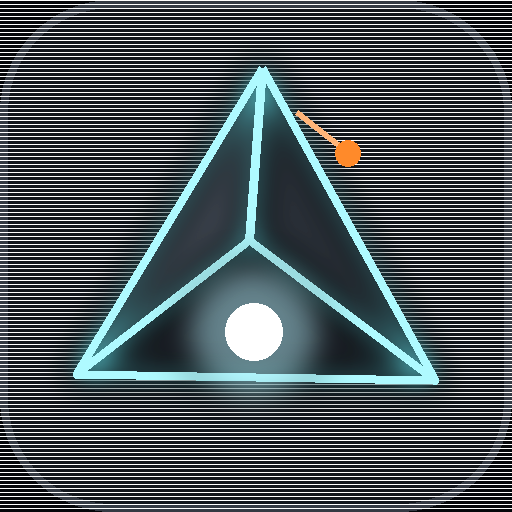
Resonant is a geometry game. You place polygon pieces on the board with a fixed budget, give each one a role, and start the wave. Then you watch what you built do its work, or fail to. In round IV the board folds into a tetrahedron, and the same rules run across its faces; later rounds fold it into a cube, an octahedron and a dodecahedron.
Nine rounds, one idea each
- Redirection
- Energy
- Selective routing
- The fold
- Field
- Dispersion
- The cube
- The dual
- Twelve
Each round's objectives are live checks shown at the top of the screen, such as keeping the core above a set integrity and resolving every spark.
How to play
Pieces
Triangle (20), square (30) and pentagon (40): the number is what each costs from your budget. Five sides is the limit, and the game tells you why.
Roles
- Reflect turns a spark away, keeping most of its energy.
- Damp absorbs most of a spark's energy and pays part of it back into your budget.
- Gate sorts what passes by a property of the spark.
- Prism bends a spark by an amount that depends on its energy.
Tools
Rotate and Remove adjust what you placed. Paths previews where sparks will go. Wave starts the round; Pause and Reset do what they say. When something you built causes an effect worth naming, a card appears under What happened; each fires once.
The model, stated
Deterministic simulation, fixed step. Reflection keeps 92% of a spark's energy, a wall 60%, the medium takes 12% a second, a damper keeps 45% and pays 12% of the rest into your budget; below 18 a spark dissipates. Speed is √energy; a prism deviates by 0.6·√(60/energy) radians per face; a field adds a constant acceleration to sparks only. Model, not nature: the numbers are tuned for play and stated so you can reason with them.